Buying an apartment building is different from buying a single-family investment property. The decision is driven less by the appearance of the property and more by income, expenses, financing, physical condition, tenant performance, and the property's potential over time.
View apartment buildings for sale: List of Apartment Buildings For Sale
For investors considering multifamily properties, understanding the process before pursuing a specific building can make it easier to identify opportunities—and recognize problems before they become expensive.
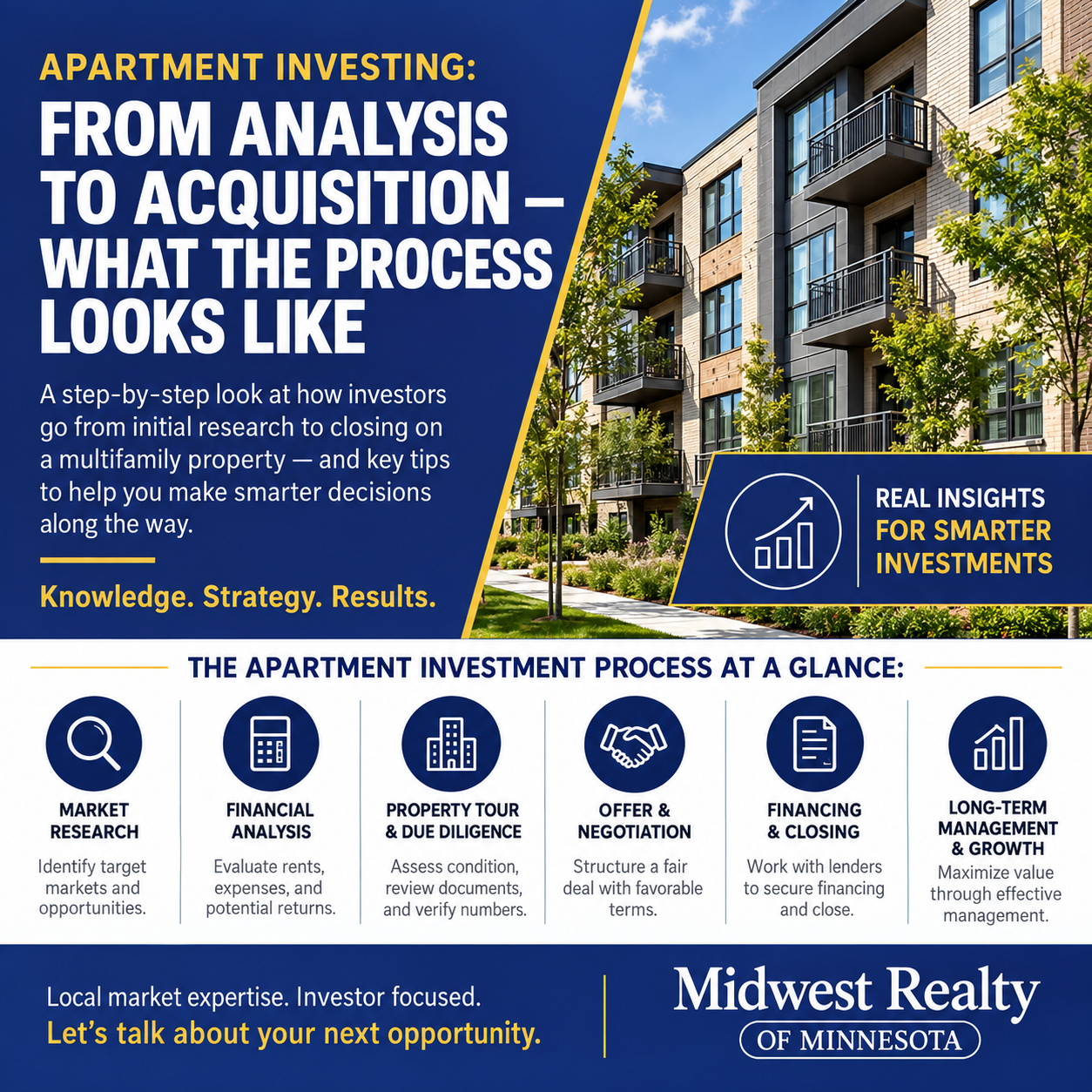
Here is how the process typically develops.
1. Market Research: Start With the Bigger Picture
Before analyzing a particular apartment building, consider the market surrounding it.
Population and employment trends, rental demand, vacancy rates, new construction, neighborhood characteristics, and prevailing rents can all influence future performance.
A property showing attractive numbers today may be less compelling if rents are weakening or substantial new supply is entering the market. Conversely, a well-located property with below-market rents may offer opportunities that aren't immediately apparent from its current income.
The objective isn't simply to find an apartment building for sale. It's to determine whether the property, location, and market work together as an investment.
2. Financial Analysis: Understand What You're Actually Buying
Apartment properties are fundamentally income-producing assets.
Initial analysis commonly includes:
- Current rent roll and market rents
- Vacancy and collection history
- Operating expenses
- Property taxes and insurance
- Utilities
- Repairs and maintenance
- Management expenses
- Net operating income (NOI)
- Capitalization rate
- Financing and debt service
- Potential capital expenditures
One of the most important distinctions is between current performance and projected performance.
A seller may emphasize what rents could be or what expenses might become. Investors should understand the property's actual historical performance first and then independently evaluate whether projected improvements are realistic.
3. Property Tour and Due Diligence: Verify the Story
Once a property appears financially viable, the analysis moves beyond the spreadsheet.
The physical property needs to support the financial assumptions.
Depending on the property, due diligence can include reviewing leases, rent rolls, operating statements, utility records, maintenance history, capital improvements, property taxes and other documentation.
Physical inspections may identify issues involving roofing, mechanical systems, plumbing, electrical components, parking areas, building exteriors, individual units, or deferred maintenance.
The objective is straightforward:
Verify that the property you are actually buying matches the property represented by the numbers.
This is also where seemingly similar apartment buildings can begin to look very different as investments.
4. Offer and Negotiation: Price Is Only One Variable
An apartment purchase agreement involves considerably more than the purchase price.
Depending on the transaction, negotiations may address financing, earnest money, inspection and due-diligence periods, document review, closing timelines and other contingencies.
The financial analysis completed earlier helps establish what price and terms make sense for a particular investor.
Rather than asking only, "What is this building worth?", an investor should also ask:
"At what price and under what terms does this investment work for me?"
Those aren't necessarily the same question.
5. Financing and Closing
Multifamily financing can differ substantially from residential mortgage financing, particularly once a property reaches five or more units.
Lenders may evaluate both the borrower and the property's ability to support the proposed debt. Loan-to-value ratios, debt-service coverage, interest rates, amortization, borrower experience, property condition and liquidity can all influence available financing.
Getting a lender involved early can help investors understand their likely purchasing range and avoid spending significant time analyzing properties that don't fit their financing structure.
As the transaction approaches closing, financing, title work, due-diligence items and other contractual requirements converge.
6. Long-Term Management and Growth
Closing isn't the end of the investment process. It's the beginning of the ownership phase.
Long-term performance can depend on maintaining occupancy, controlling expenses, managing tenant turnover, addressing deferred maintenance, planning capital improvements and periodically evaluating rents against the surrounding market.
This is also where the property's unit mix becomes particularly important.
A building's combination of studios, one-bedroom, two-bedroom, three-bedroom or larger units can influence tenant demand, turnover, achievable rents and long-term performance.
That's why two apartment buildings with similar purchase prices and similar headline capitalization rates can ultimately produce very different results.
Look Beyond the Headline Numbers
There usually isn't one number that determines whether an apartment building is a good investment.
Cap rate matters. So do rents, expenses, financing, physical condition, location, unit mix, tenant demand and the investor's objectives.
The better approach is to evaluate those factors together.
An attractive asking price doesn't necessarily create an attractive investment—and a property that initially appears ordinary may become considerably more interesting once its underlying numbers and opportunities are understood.
Considering an Apartment Investment?
Midwest Realty of Minnesota works with investors evaluating multifamily and commercial real estate opportunities throughout the Twin Cities and surrounding Minnesota markets.
Whether you're beginning your search, evaluating a particular apartment building, or looking to expand an existing portfolio, we can help you analyze opportunities and navigate the acquisition process.
View apartment buildings for sale: List of Apartment Buildings For Sale
Midwest Realty of Minnesota
MidwestRealtyMN.com
651-472-4012